How to Find Niche-Relevant Guest Post Opportunities

Finding guest post opportunities is easy. Finding the right ones is where most campaigns fall apart.
A lot of people build huge prospect lists full of sites that technically accept guest posts but do almost nothing for rankings, referral traffic, or brand authority. The list looks productive, but the results are weak because the sites are off-topic, thin on real readership, or clearly built to sell placements.
If you want guest blogging to help SEO without drifting into spammy territory, you need a relevance-first process. That means starting with niche fit, then checking authority, traffic, editorial quality, and only then pitching. This is the foundation for anyone looking to get guest posts on high DR websites without compromising on quality. Google’s guidance has been consistent on this point: it rewards helpful, people-first content and warns against large-scale guest posting done mainly to manipulate links.
TL;DR
- Niche-Overlap vs. General Interest: A link from a CRM blog for real estate agents is 5x more powerful for a real estate software than a link from a general "business tips" blog.
- Audience Mirroring: Verify relevance by checking if the site's social media followers and commenters "mirror" your actual customer persona. If the audience feels disconnected, the niche fit is only surface-level.
- Automated Relevance Vetting: Use Rankchase's Free Website Analyzer and its Niche Quality Score to confirm that a site's top-performing pages actually match its stated niche, avoiding high-DR sites that rank for "junk" terms.
- Niche-First Discovery: Use Rankchase to automate the search for high-relevance guest post partners, focusing on sites with proven audience overlap rather than just raw authority metrics.
- The "Editorial Logic" Test: If an article wouldn't make sense or provide value without your backlink, the pitch is too link-driven and likely to be flagged as spam.
- Expert-Led Pitching: Propose specific angles like "Angle = audience pain point + specific outcome + proof source" to land placements on high-tier publications that reject generic "10 tips" content.
This guide walks through that process step by step, using the exact workflow many SEOs use in practice:
- understand why niche relevance matters
- find real opportunities efficiently
- sort good sites from junk
- pitch ideas that actually get accepted
Why Niche Relevance is Crucial for Guest Blogging
Before you build a list, you need to know what you are optimizing for.
A niche-relevant guest post is not just a page where you can place a link. It is a placement on a site whose audience, topics, and editorial direction overlap meaningfully with yours. That overlap affects how natural the link looks, how useful the article is to readers, and whether the placement can send qualified traffic.
Building a Strong, Natural Backlink Profile
Relevance is the difference between a backlink profile that looks earned and one that looks assembled.
If your SaaS product gets mentions from B2B marketing blogs, sales ops publications, and analytics websites, that pattern makes sense. If the same site suddenly gets guest post links from random pet blogs, home decor magazines, and coupon directories, the profile starts looking manufactured.
Google explicitly warns against large-scale article marketing or guest posting campaigns with keyword-rich anchor text links, and it also recommends natural anchor text rather than stuffing keywords into links.
So the practical rule is simple:
- Topical match first
- Identify Niche-Overlap vs. General Interest. A link from a CRM blog for real estate agents (Niche-Overlap) is far more powerful for a real estate software than a link from a general "business tips" blog.
- Brand or natural anchors more often than exact match
- One strong placement beats five irrelevant ones
- If the article would make sense even without the backlink, you are usually on safer ground
A quick self-test helps here. Ask: Would this article still be a useful contribution if my link were removed? If the answer is no, the pitch is probably too link-driven.
Driving High-Intent Referral Traffic
This is the part people ignore when they think only in terms of DR.
A relevant guest post can send visitors who are already close to your use case. Those readers do not need a long explanation of why the topic matters because they came from a site they already trust in your niche.
For example, if you sell bookkeeping software for agencies, a post on a generic “business tips” blog may send some traffic. A post on an operations blog read by agency owners will usually send less volume but better clicks, better engagement, and more realistic conversions.
When I qualify opportunities, I look for this sequence:
- The host site ranks and publishes in the same topic neighborhood
- The guest topic solves a problem that overlaps with my offer
- The linked page is the natural next step for that reader
If any of those three are missing, the traffic value drops fast.
Increasing Brand Awareness and Authority
Good guest posting compounds because it puts your brand in the right rooms repeatedly.
When your byline shows up on respected sites in your space, readers start recognizing your name, your company, or your expertise. That brand effect is hard to measure in a spreadsheet, but it matters. This is a key benefit of learning how to get backlinks from high authority publications consistently. It also aligns with Google’s people-first content guidance, which emphasizes originality, first-hand expertise, and clarity about who created the content.
This is especially important in tougher verticals like health, finance, legal, and B2B SaaS. In those spaces, a generic article on a weak blog does very little. A useful article on a trusted niche publication can improve perceived authority with readers, editors, and future partners.
Proven Methods to Discover Guest Posting Sites in Your Niche
Once you understand what relevance looks like, the next step is prospecting.
The goal here is not to scrape the internet for every site with a “write for us” page. The goal is to find websites that are both open to contributions and worth contributing to.
Using Advanced Google Search Operators
Search operators still work well enough for prospecting if you use them with narrow intent and realistic expectations. Exact-match queries and operators like site: and intitle: remain useful, but they are not perfect, so always validate manually.
Start with combinations like these:
"your niche" "write for us""your niche" "guest post""your niche" "contribute"intitle:"write for us" "your niche"intitle:"guest post" "your niche""your niche" inurl:guest-post"your niche" "submit an article"
If your niche is too broad, add a subtopic. Instead of searching fitness "write for us", search strength training "write for us" or sports nutrition "contribute".
Here is a simple workflow that works well:
Two practical tips matter a lot here.
First, search for topic phrases, not just industry labels. “Email deliverability” will often surface better prospects than “SaaS marketing.”
Second, look beyond explicit guest post pages. Some of the best opportunities come from sites that accept expert contributions but label them “contributor guidelines,” “editorial submissions,” or “expert insights.”
Reverse-Engineering Competitor Backlinks
This is usually the fastest way to find sites that already say yes to content partnerships.
If a competitor has earned links from niche blogs, industry publications, or recurring contributor columns, those placements give you a map of what is working in your space right now.
Use a backlink tool to review referring domains and filter for:
- blog or editorial pages
- author bio pages
- pages with “guest post,” “contributor,” or “opinion”
- domains sending actual organic traffic
- sites with multiple articles in your topic cluster
Metrics can help, but use them correctly. Ahrefs describes Domain Rating as a proprietary measure of backlink profile strength, not a direct measure of legitimacy, and even Ahrefs notes that a low DR alone does not mean a site is spammy. Semrush’s Authority Score also includes signals like organic traffic and suspicious SEO behavior, which makes it more useful as a screening aid than a final verdict.
My rule here is:
- Use metrics to prioritize
- Use manual review to decide
Automating Niche Relevance Vetting
Instead of manually checking every prospect, you can use the Bulk Domain Checker to validate relevance at scale. The tool analyzes the top pages of any domain to ensure the traffic is coming from keywords that actually belong to the niche. This prevents you from pitching to sites that have high authority but rank for completely unrelated, low-value terms.
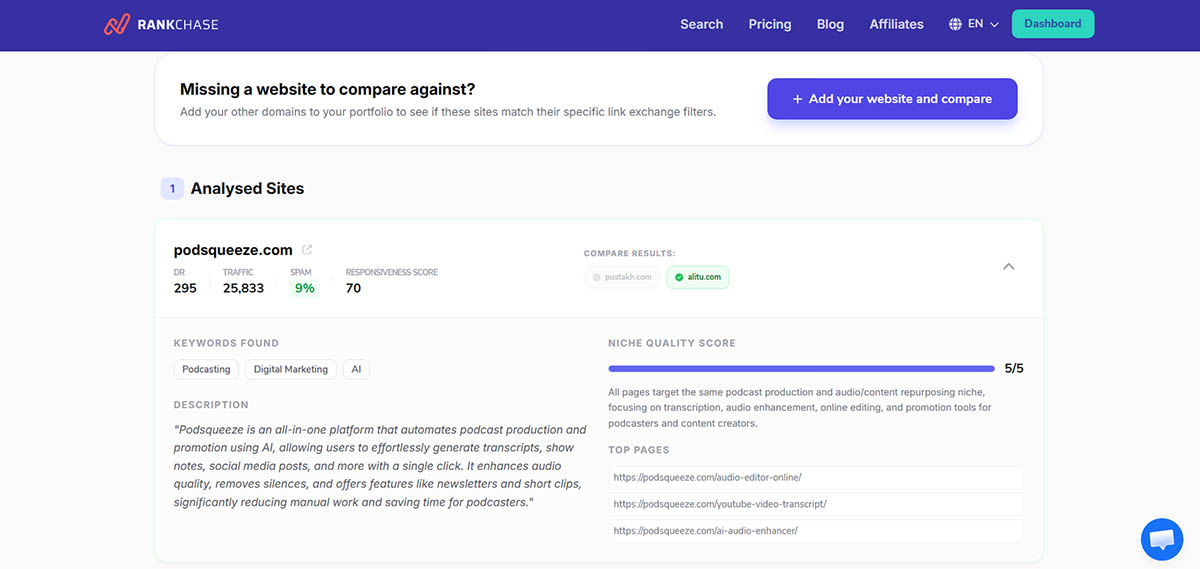
A domain with modest authority but strong topical fit and real readership can be far more valuable than a higher-metric site publishing random contributed content across 20 industries.
If you want to speed up this stage, a filtering tool like Rankchase can help narrow websites by relevance, authority signals, traffic patterns, and spam indicators so you spend more time reviewing plausible matches instead of cleaning bad lists. This is a key part of learning how to scale guest post prospecting effectively.
Scouting Opportunities on Social Media
Social platforms are useful because editors often announce contributor openings there before their site pages are easy to find in search.
This works especially well on LinkedIn and X, where editors, founders, and content managers post calls for expert contributions, roundup requests, and editorial themes.
Search for phrases like:
- “looking for contributors”
- “accepting guest posts”
- “seeking expert commentary”
- “editorial submissions open”
- “want to write for us”
Then check the poster’s site, not just the social post.
This method is especially good for niches where guest posting is less formal. In B2B, tech, healthcare, and founder-led media, the opportunity is often framed as expert contribution, case study, or commentary rather than a standard guest article.
A useful decision rule here:
- If the site has a clear audience and strong editorial voice, follow up
- If the account mainly reposts paid placement offers, skip it
That one filter saves a lot of wasted outreach.
Leveraging Curated Lists of Blogging Sites
Curated lists can save time, but they are dangerous if you treat them as ready-made outreach targets.
Most lists are outdated, recycled, or mixed with sites that accept almost anything. Use them as discovery sources, not approval signals.
What I do with curated lists:
- copy out only domains that look topically relevant
- open each site manually
- check recent articles, author quality, and traffic footprint
- discard anything that looks like a marketplace site in disguise
A list is useful when it helps you surface domains you would not have found otherwise. It is not useful when it becomes your final prospect list. For those starting out, knowing where to find free guest post sites can be a great way to build initial momentum without a large budget.
If a site appears on every “500 guest post sites” list, treat it with extra suspicion. The best placements are often less obvious and more selective.
Popular Industry Categories That Accept Guest Contributions
Some industries are naturally more open to guest contributions than others.
That does not mean every site in those categories is a good target. It just means the model is common enough that you can usually find legitimate opportunities with a focused search.
Digital Marketing, SEO, and Business Blogs
This is one of the easiest categories for discovery and one of the hardest for quality control.
A lot of marketing sites publish contributed content, but many also drift into link-selling, recycled listicles, and generic advice. The good opportunities are still there, but you need tighter filters.
Look for sites that publish:
- original case studies
- channel-specific tactical content
- editor-reviewed opinion pieces
- contributor bios with clear expertise
Skip sites where every post has two exact-match commercial anchors and no comments, no author credibility, and no real topical focus. It's also important to verify contributor access to ensure the site is still actively publishing external content.
Technology and Web Development Websites
Tech sites are a good fit when your product or expertise has a clear technical angle.
Developers, product teams, and technical marketers respond better to posts with real implementation detail. That means tutorials, benchmarks, migration stories, architecture lessons, and tooling comparisons tend to work better than broad thought leadership.
A strong pitch here usually includes:
- a specific stack or tool context
- a practical takeaway
- screenshots, code, or process detail
- an author with direct experience
If your article reads like generic top-of-funnel content, it will usually underperform on serious tech publications.
Health, Fitness, and Medical Platforms
This category needs extra caution.
Health and medical topics sit much closer to Google’s trust-sensitive standards, so low-quality guest posting is especially weak here. Google places strong emphasis on trust and expertise for topics that can affect people’s health or financial stability.
If you work in health or wellness, prioritize sites with:
- qualified contributors
- cited claims
- clear editorial review
- author pages that show credentials
- content depth beyond trend pieces
For fitness sites, relevance can still be narrower than people think. A women’s strength training blog, a marathon training site, and a supplement review site may all sit under “fitness,” but they attract different readers and require different content angles.
Finance, Real Estate, and Legal Blogs
These verticals can produce excellent guest post opportunities, but they are also crowded with low-trust placements.
You need to be stricter about both editorial standards and business legitimacy. Look for firms, publishers, associations, or specialist blogs with clear subject focus. A tax strategist writing for a real estate investing site makes sense. The same strategist posting on a general entertainment blog does not.
Good signs include:
- bylined expert articles
- compliance-aware content
- original examples or commentary
- topic depth within one subfield
Bad signs include anonymous content, broad unrelated categories, and obvious monetization through mass placements.
Lifestyle, Travel, and Parenting Websites
These sectors are broad, which creates both opportunity and noise.
Because the topics are flexible, many sites in these spaces accept guest posts. But broad niches also attract thin sites built around sponsored content and affiliate monetization. You might find better results by looking for real US and UK blogs that maintain higher editorial standards. So you need to check whether the audience is real.
This category works best when your angle is genuinely audience-centered. For example:
- a family travel brand contributing to a parenting travel blog
- a sleep consultant writing for a parenting site about toddler routines
- a remote work tool contributing to a digital nomad travel publication
The tighter the audience overlap, the better the placement tends to perform. This is particularly true when you find guest post sites by country to target specific regional demographics.
How to Evaluate and Qualify a Guest Blogging Website
Prospecting gives you candidates. Qualification tells you which ones are worth your time.
This is where most of the SEO value is won or lost.
Checking Domain Metrics and Organic Traffic
Start with a fast quantitative screen, but do not stop there.
At minimum, check:
- estimated organic traffic
- traffic trend over time
- referring domains
- authority metric such as DR or Authority Score
- whether the site ranks for relevant topics, not just branded terms
Remember what these metrics actually mean. DR is about backlink profile strength, not a spam verdict, and Authority Score is a blended estimate that includes organic and suspicious-profile signals. They are useful for triage, not truth.
A quick qualification checklist:
- Traffic is stable or growing
- The site ranks for niche terms
- Recent articles are being indexed
- The domain is not inflated by irrelevant foreign traffic
- The site is not publishing dozens of unrelated guest posts per week
If a site has high DR but near-zero topical traffic, treat that as a warning sign. In real campaigns, that pattern often shows up on expired-domain rebuilds and placement farms. This is why it's essential to find guest post sites with real traffic and not just high metrics.
Ensuring True Audience Alignment
This is the most important filter and the one many teams rush through.
Open the site like a real visitor and ask:
- Who is this for?
- What recurring problems does the content solve?
- Would my target customer actually read this site on purpose?
- Perform Audience Mirroring. Look at the comments section and the site's social media engagement. Does the tone of voice and the type of questions asked by the readers "mirror" your actual customer persona? If the audience feels fake or disconnected, the niche relevance is only surface-level.
Then go one level deeper.
Check the recent posts. Do they align with your topic cluster? Do the headlines target the same stage of awareness as your audience? Do the CTAs and products advertised on the site suggest the same type of reader you want?
A quick example:
If you sell local SEO software for agencies, a broad “small business tips” site may be somewhat relevant. But an agency operations blog, local marketing publication, or marketing automation site is a much stronger fit because the audience intent is closer. You can also find link insertion opportunities on these highly relevant sites to boost your authority.
This is why audience alignment beats raw metrics. A smaller site with the right readers often outperforms a bigger but looser match.
Reviewing the Quality of Existing Guest Authors
The easiest way to spot a bad guest post site is to read its previous guest posts.
Look for patterns.
If existing contributed articles are shallow, stuffed with awkward anchors, or published under vague author profiles, your article will be joining a weak neighborhood. That reduces the SEO upside and increases the chance that the placement is ignored by readers and algorithms alike.
Use this green flag vs red flag table:
Also check whether the site discloses sponsored content and qualifies commercial links appropriately. Google recommends using rel="sponsored" for links with a commercial nature, and it warns that excessive sponsored and guest posting without proper link tagging can lead to reassessment or manual action.
That does not mean every partnership is bad. It means you should favor editorial fit, moderation, and transparency over scale.
Best Practices for Pitching and Getting Published
Once your prospect list is clean, outreach gets much easier.
At this stage, the mistake is usually not “bad email writing.” It is pitching the wrong idea to the wrong editor. Fix that first, then write a clean pitch.
Read and Follow the Editorial Guidelines Strictly
This sounds basic, but it is one of the biggest acceptance levers.
Editors can tell immediately when someone did not read the guidelines. The article length is wrong, the formatting is wrong, the examples are generic, or the pitch duplicates topics they already covered.
Before you send anything, check:
- topic preferences
- contributor rules
- link policy
- formatting requirements
- author bio instructions
- whether they want full drafts or topic pitches first
Google’s people-first content guidance is useful here too. Original information, substantial coverage, clear expertise, and satisfying reader experience are exactly the traits strong editors want anyway.
If the site’s standards feel too demanding, that is often a good sign.
Propose Problem-Solving, Original Content Ideas
Editors do not want another recycled “10 tips” article unless you have a truly fresh angle.
The best pitches usually do one of three things:
- solve a very specific reader problem
- bring first-hand data or experience
- connect two adjacent topics in a useful way
Here is the framework I use:
Angle = audience pain point + specific outcome + proof source
Examples:
- For a technical SEO audience: “How we reduced crawl waste on a 200k-page ecommerce site”
- For a startup finance audience: “Cash flow reporting mistakes that distort SaaS forecasting”
- For a parenting audience: “What changed when we tested a consistent bedtime routine for toddlers who wake early”
Those are stronger than “Top Tips for Better SEO” because they signal specificity and real experience.
If your proposed title could fit on any website in any industry, it is probably too generic to win a good placement.
Craft a Professional and Personalized Outreach Email
Personalization is not about fake flattery. It is about showing that your pitch belongs on that site.
A good outreach email is short and proves three things fast:
- you know the audience
- you have a relevant idea
- you can deliver a clean draft
A practical structure looks like this:
- short opener tied to the site
- one-line credibility context
- 2 to 3 topic ideas with concrete angles
- mention that you will follow editorial guidelines
- polite close
For example:
Hi [Name],
I’ve been reading your recent content on technical content strategy, especially the pieces aimed at in-house SaaS teams. I work with brands on link building and editorial partnerships in the SEO space, and I had a few article ideas that feel like a fit for your audience:
- How to qualify guest post opportunities without over-relying on DR
- A practical workflow for finding niche-relevant link partners
- Common red flags that make contributed content look manipulative
Happy to draft any of these to your guidelines and keep it fully original.
That is enough.
No oversized intro. No life story. No “I hope this email finds you well” if the pitch itself is weak.
Frequently Asked Questions About Finding Guest Posts
How do I know if a guest post site is high quality?
Use a layered test.
First, confirm the site is topically relevant. Then check whether it gets real organic traffic, publishes useful content consistently, and maintains quality across both staff and guest articles. Finally, review the outbound links and anchor patterns.
A high-quality guest post site usually has:
- a clear niche
- real editorial standards
- visible audience fit
- stable organic presence
- natural linking patterns
If the site looks built to host articles rather than serve readers, skip it.
Are free guest posting opportunities effective for SEO?
Yes, if they are genuinely relevant and editorially sound.
Free does not mean low quality. Many strong niche sites accept expert contributions at no charge because they want good content. In fact, free placements are often cleaner because the relationship is editorial rather than transactional.
What matters is site quality, audience fit, and content value, not whether money changed hands. Google recommends qualifying those links appropriately if there is a commercial arrangement involved.
In practice, a free post on a respected niche site can outperform a paid placement on a stronger-looking but less relevant domain.
Is it better to pay for a guest post or find free options?
Free, editorial opportunities are usually the better default.
Paid placements can introduce risk when the site is clearly selling links at scale or when the arrangement drives unnatural linking behavior. Google specifically warns about excessive sponsored and guest posting used to manipulate rankings, and recommends rel="sponsored" for commercial links.
That said, not every collaboration involving compensation is automatically toxic. The web is full of legitimate commercial relationships, partnerships, and sponsored publishing arrangements. The deciding factors are relevance, transparency, moderation, and editorial justification.
If you are weighing the two, use this rule:
- Choose free editorial placements when possible
- Consider paid collaborations only when the publication is legitimate, the audience fit is strong, the content is truly useful, and the link treatment follows appropriate standards
The safest long-term strategy is still the same one we started with: publish useful content on sites your audience actually reads.
That approach takes more effort, but it builds the kind of guest post profile that holds up over time.