How to Get Guest Posts on High DR Websites

Guest posting on high DR websites still works, but only when you treat it like editorial PR with SEO upside, not like bulk link building.
That difference matters.
If you chase any site with a high Domain Rating, you will waste time on dead contributor pages, overpriced sponsored placements, and blogs that look strong in a tool but pass very little real value. Ahrefs describes DR as a relative domain-level metric, not a direct measure of site quality, which is why smart prospecting always goes beyond the DR number.
This guide walks through the process the way experienced link builders actually do it: find relevant sites, filter hard, pitch the right editor, write something worth publishing, and avoid placements that create more risk than value. This often starts with knowing how to find niche-relevant guest post opportunities that align with your specific expertise.
TL;DR
- The "Credential" Strategy: Use a publication on a DR 70 site as a proof point to land your next pitch on a DR 85+ site. High-tier editors prioritize contributors who have already passed the bar at peer publications.
- Social Warming: Before pitching a high-DR editor, interact with their content on LinkedIn/X for 1-2 weeks. Familiarity increases your email open rate by up to 50%.
- Vetting for "Link Farms": High DR can be faked or rented. Use Rankchase's Free Website Analyzer to flag these via the Niche Quality Score, ensuring the site's traffic is topically relevant.
- Premium Discovery: Skip the manual hunt and use Rankchase to find high-DR websites that are already open to expert collaborations and niche-relevant guest posts.
- Data-Rich Pitching: High-authority sites like HubSpot or MarketingProfs reject generic "10 tips" content. Pitch original experiments, teardowns, or internal datasets to stand out.
- Exclusivity is Mandatory: Never reuse guest posts. Premium sites expect first-publication rights and original content tailored specifically to their audience.
Why Focus on High DR Guest Posting?
High DR guest posting is not about collecting vanity metrics. It is about getting published on sites that already have trusted link profiles, editorial standards, and audience reach.
If you do this well, one guest post can help rankings, send referral traffic, strengthen brand perception, and open the door to future collaborations.
Building a Powerful Backlink Profile
A link from a strong site can carry more weight than several links from weak sites because authoritative domains tend to have stronger backlink equity to pass. That is the basic reason SEOs care about high DR opportunities in the first place. But you should keep the nuance straight: DR is relative, and a high-DR domain that links out recklessly can still be a poor target.
Here is the practical rule I use:
- Start with relevance
- Use DR as a filter, not the final decision
- Prefer pages and sections that already rank and get crawled
- Aim for editorial links that make sense even without SEO
If your SaaS company gets a contextual link from a respected B2B marketing publication inside a genuinely useful article, that link usually does more for your profile than a random DR 80 site that publishes casino, CBD, fintech, and “best CRM” posts all in the same week.
Google’s spam policies are clear that excessive link exchanges and large-scale article campaigns built mainly for links can violate policy, which is why quality and editorial intent matter so much here.
Driving Targeted Referral Traffic
A lot of guest posts get zero clicks because they are published on pages no real person reads.
A high DR site helps, but the better question is this: does this publication have the right audience and does this section actually attract readers?
Check three things before you pitch:
- Does the site publish for your buyer or your industry peers?
- Does the article category get fresh comments, shares, or ranking traffic?
- Can your topic solve a problem the audience already has?
This is why a DR 68 niche operations blog can outperform a DR 90 general business site for referral traffic. The audience fit is tighter, the click intent is stronger, and your byline feels more credible.
When referral traffic is the goal, avoid vague thought leadership. Pitch titles that promise a clear outcome, such as:
- How We Cut Demo No-Shows by 27% With a Two-Step Email Sequence
- A 14-Day Technical SEO Triage for Sites With Under 10k Pages
- What Broke After Our CMS Migration and How We Fixed It
Those angles attract the right readers because they sound lived-in, not outsourced.
Boosting Brand Authority and Trust
Getting featured on a respected site changes how people perceive your brand.
Prospects search your company, see you quoted or published on known industry sites, and assume you know what you are doing. Recruiters notice. Partners notice. Journalists notice. Future editors notice. This is why learning how to get backlinks from high authority publications is a long-term investment in your brand's digital reputation.
This is why smart teams do not look at guest posting as a one-off link tactic. They use it to build a credible footprint across sites their market already trusts.
A simple mental model helps here:
- SEO value comes from the link
- Brand value comes from the logo and publication context
- Compounding value comes when that article becomes a proof point in future outreach
- Portfolio Building. Use your publication on a DR 80 site as a "credential" to land your next pitch on a DR 85+ site. High-tier editors are more likely to say yes if they see you've already passed the bar at a peer publication.
That last part is underused. Once you publish on one strong site, your next pitch becomes easier because you can point to a real example of your work.
How to Find High-Authority Guest Blogging Opportunities
Once you know why high DR placements matter, the next job is building a prospect list that is not full of junk.
Most people either search too broadly or rely too much on a single tool. The better approach is to combine search operators, backlink research, and reverse engineering so you uncover sites that actually publish contributor content right now. This is crucial when you want to scale guest post prospecting without falling into the trap of using low-quality junk lists.
Leveraging Advanced Google Search Operators
Search operators still work, but only when you use them with intent.
Do not just search write for us + marketing and scrape the first 100 results. That query is crowded with low-quality pages that exist only to attract pitches.
Use operators that reveal editorial patterns instead.
Try combinations like these:
"guest post" "your keyword"
"contributor guidelines" "your keyword"
"inurl:write-for-us" "your keyword"
"become a contributor" "your keyword"
site:.com "your keyword" "guest author"
site:.com "your keyword" "contributed by"
Then add modifiers that narrow the field:
"saas" "guest author"
"b2b marketing" "editorial guidelines"
"cybersecurity" "contributor"
What you are looking for is not just a guidelines page. You want evidence that the site is still accepting and publishing outside contributors.
Check the SERP result, then click through and verify:
- The guidelines page still exists
- Recent articles show external authors or contributor labels
- The topics match your expertise
- The publication has not turned into a pay-to-play portal
A useful shortcut is to search for footprint phrases inside a niche. For example, if many sites use “contributed by” in bylines, search that phrase with your target topic. It often surfaces publications that do not have a public “write for us” page but do publish outside experts.
Prospecting Competitor Backlinks with SEO Tools
This is usually the fastest way to find realistic targets.
Open a competitor that actively invests in content marketing. Pull their referring domains and filter for links coming from articles, author bios, contributor pages, or editorial content.
You are looking for patterns like:
- Multiple competitors appearing on the same publication
- Author bio links from niche sites
- Contributor posts tied to founders, heads of marketing, or product leaders
- Mentions inside tactical articles, not just listicles
This tells you where your market already accepts outside expertise.
A clean workflow looks like this:
- Export a competitor’s referring domains
- Filter for domains with decent authority and topical relevance
- Open the linking pages
- Tag each one as guest post, digital PR, resource mention, partnership, or editorial quote
- Prioritize domains where contributor content is clearly part of the editorial model
This is where a platform like Rankchase can fit naturally into the workflow. If you are trying to find niche-relevant collaboration partners without manually checking every domain, using automated filters for relevance, DR, traffic patterns, and spam signals can speed up the shortlisting phase.
The important part is still your judgment. Tools help you narrow the list. They do not replace vetting.
Finding Opportunities Through Reverse Engineering
Reverse engineering is how you find the sites everyone else misses.
Instead of searching for guest post pages, study the sites that already publish the kind of article you want to place.
Look at:
- The author bylines on top-ranking posts
- Whether contributors link to personal brands or company sites
- The editorial style of accepted articles
- The topics they invite from external experts
Here is a simple reverse-engineering play:
Say you want placements in SEO and content marketing.
Search a topic like “content audit framework” or “technical SEO checklist.” Open strong results and ask:
- Is this written by staff or a contributor?
- If contributor, what kind of profile did they have?
- Is the article opinion-based, data-based, or tutorial-based?
- Does the site repeatedly publish outside specialists?
If the answer is yes, you may have a real target even if no public submission page exists.
This is also how you find editors who care about specific angles, not just generic topics. A site that has recently published tactical teardown posts may be far more receptive to “what we tested and what happened” than to “10 tips for SEO success.”
Vetting Prospects to Ensure True Quality
A long prospect list is useless if half the sites on it are dressed-up link farms.
This stage is where good campaigns separate from messy ones. You are not just asking, “Is the DR high?” You are asking, “Would I still want this placement if the link were nofollow?”
If the answer is no, the site probably does not belong on your list.
Spotting the Difference Between Real Blogs and Link Farms
A real publication feels consistent. A link farm feels assembled.
You can often tell in under two minutes.
Here is a fast comparison:
If a site publishes “best payroll software,” “roof repair tips,” “crypto staking,” and “dog nutrition” in the same week, move on.
Also inspect the article pages themselves. Link farms usually leave fingerprints:
- Exact-match anchors jammed into the body
- Author bios that exist only to carry links
- No comments, no engagement, no sense of editorial ownership
- Categories with thousands of barely related articles
- “Sponsored” options visible everywhere, even if they pretend to be editorial
If a site’s business model feels like selling article slots first and serving readers second, treat the placement as a risk, not an opportunity.
Key Metrics to Check Beyond Domain Rating (DR)
This is where intermediate SEOs make better decisions.
DR is one input. It should never be the whole decision.
Ahrefs notes that DR is domain-level, while URL Rating is page-level. That matters because your guest post will live on a page, not inside the abstract idea of a domain.
When vetting, check these additional signals:
1. Organic traffic trend
If the domain has lost most of its traffic over the last year, the brand may have been hit, devalued, or abandoned.
2. Relevance of ranking pages
A real site ranks for topics related to its stated niche. A manipulated site often ranks for scattered, low-quality terms.
3. Referring domain quality
Look at where the site gets links from. If its backlink profile is mostly directories, foreign-language junk, or obvious PBN-looking sites, ignore the DR.
4. Outbound link behavior
Open recent articles. If nearly every post contains commercial links to unrelated companies, that is a bad sign.
5. Indexation and freshness
Search site:domain.com and scan recent pages. If new posts are not getting indexed or everything looks stale, the publication may have low editorial momentum.
6. Page-level strength
Ask where your article would live. On a blog category that gets internal links and traffic, or on an orphaned “contributor” section? You can also find link insertion opportunities on existing high-traffic pages to get immediate value.
Quick Vetting with the Bulk Domain Checker
Before spending hours on a pitch, run your target domains through the Bulk Domain Checker. It gives you a high-level view of DR, traffic, and spam risk instantly. The tool's Niche Quality Score is particularly useful for high-DR sites, as it confirms whether that authority is backed by relevant, high-quality content or just inflated by random keywords.
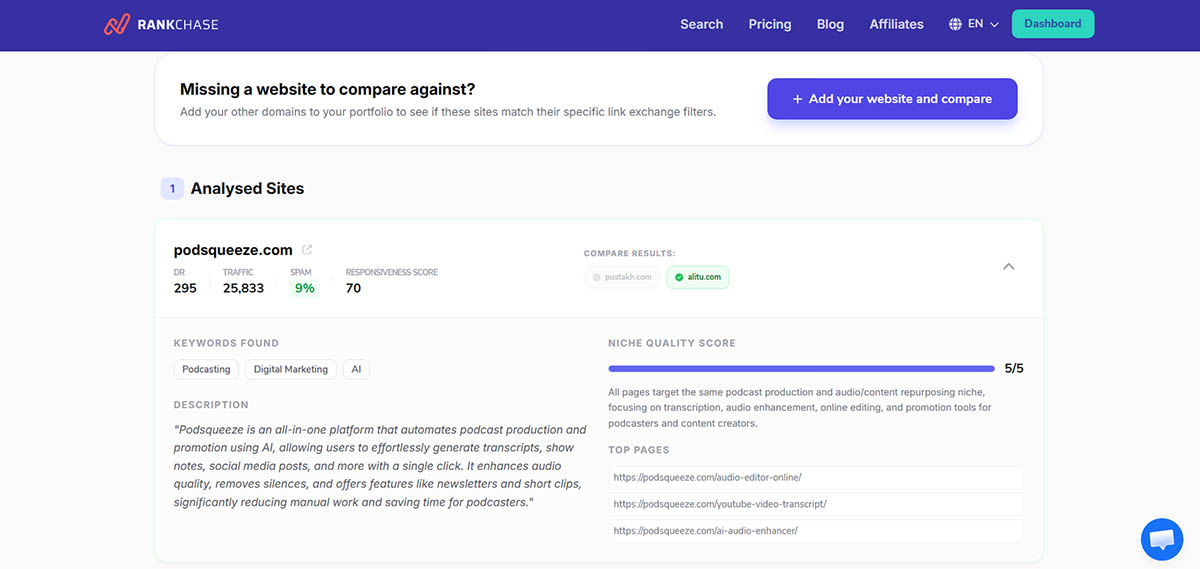
Use this quick decision rule:
- Relevant niche + steady traffic + normal outbound links + real editorial standards = good target. This is the best way to find guest post sites with real traffic and DR that actually move the needle.
- High DR + weak topical fit + obvious sponsored footprint = skip
- Mid DR + strong niche fit + trusted readership = often worth more than the flashy DR target
Pitching Top-Tier Editors: Outreach Strategies That Work
At this point, you should have a short list of sites worth contacting.
Now the game changes. You are no longer doing SEO research. You are selling an editor on why your idea belongs in their publication.
Most outreach fails because it asks the editor to do too much thinking. Good outreach makes the decision easy.
Finding the Right Contact Person
Start with the person who actually owns the content area you are pitching.
That is usually:
- A section editor
- Managing editor
- Content editor
- Editorial inbox for a category
- Occasionally the site’s contributions form
Do not default to generic marketing contacts unless that is the only route.
The fastest path is:
- Find the contributor guidelines or editorial page
- Check recent articles in your topic area
- Identify the editor attached to that section
- Use the most direct valid contact method available
For some publications, the process is explicit. It's also vital to verify contributor access for guest posting sites to ensure your content actually gets published and isn't stuck in a "pending" black hole. HubSpot’s guest blogging guidelines outline what they look for in submissions, including original, data-rich, personality-driven posts, recent data, limited self-serving links, and internal linking expectations.
MarketingProfs openly shares its guest submission requirements and notes that publication can take up to four months, which is useful when planning campaign timelines.
Entrepreneur is a different case. Its contribution model runs through the Entrepreneur Leadership Network, which is an application-based program rather than a simple free guest post channel.
That is exactly why you should verify the submission path before pitching. “High DR site” does not automatically mean “open for standard guest posts.”
Structuring a High-Converting Outreach Email
Editors do not want your life story. They want a clean idea with clear audience fit.
A strong outreach email has five parts:
1. A subject line that sounds editorial
Bad: Guest Post Opportunity
Better: 3 data-backed ideas for your B2B marketing audience
2. A first line that proves relevance
Reference a specific article, content gap, or audience angle. Keep it real. No fake flattery.
3. A short credibility line
Who are you, and why are you qualified to write this?
4. Two or three concrete pitch ideas
Each should feel publishable already.
5. A low-friction close
Invite them to pick one idea or ask for a draft.
Here is the formula:
Subject: 3 practical guest post ideas for [Site]

Hi [Name],

I enjoyed your recent piece on [specific topic], especially the section on [specific detail]. I work on SEO/content growth in [your niche], and I had a few article ideas that I think would fit your audience.

1. [Specific title]
What it would cover: [1 sentence outcome-focused summary]

2. [Specific title]
What it would cover: [1 sentence summary]

3. [Specific title]
What it would cover: [1 sentence summary]

A bit of context: I’ve worked on [brief proof], and I can write these as fully original, non-promotional pieces with examples/screenshots/data where useful.

If one of these is a fit, I’m happy to send an outline or a draft.

Best,
[Name]
That works because it is easy to scan, easy to forward, and easy to say yes to.
Templates and Examples of Successful Pitches
Here are two versions that tend to perform well.
Template 1: The tactical specialist pitch
Subject: Guest contribution idea for your SEO audience

Hi [Name],

I’m reaching out with a possible contributed article for [Site].

I lead SEO content work for a B2B brand, and recently built a workflow for auditing decaying blog content across 700+ URLs. I think your readers would get value from a practical breakdown.

Proposed title:
How to Prioritize Decaying Content Without Rewriting Your Entire Blog

It would include:
- the exact scoring logic we used
- how we separated traffic decay from intent mismatch
- examples of pages we merged, refreshed, or redirected
- the results after 60 days

If helpful, I can send a tighter outline first.

Best,
[Name]
Why this works: it shows real experience, clear scope, and a plausible article.
Template 2: The data-led pitch
Subject: Possible contributed piece with original data

Hi [Name],

I have a data-backed article idea that may fit [Site].

We analyzed [dataset/topic] across [size/sample], and the pattern was surprising: [brief finding]. I think this could work as a contributed piece for your audience.

Working title:
What [dataset] Reveals About [topic] in 2026

The article would focus on:
- the method we used
- the main findings
- what practitioners should do differently
- charts/screenshots for clarity

I can keep it non-promotional and align it with your editorial style.

Open to sending an outline if useful.

Best,
[Name]
Why this works: editors like original information because it gives them something their competitors do not have.
Short outreach checklist:
- Did you pitch one audience-fit idea, not a vague topic?
- Did you show actual experience?
- Did you make the editor’s next step easy?
- Did you avoid asking for links, anchor text, or SEO terms in the first email?
If not, fix the pitch before sending.
Writing Content That High DR Sites Will Actually Publish
Getting a “yes” is only half the job.
A lot of contributors lose good placements because the draft reads like a rewritten blog post from 2022 with a branded link hidden in paragraph four.
Top-tier sites publish content that makes them look smart. Your draft has to do that job for them.
Strictly Following Editorial Guidelines
This sounds obvious, but it is where good opportunities die.
Read the guidelines line by line and build your draft around them. If the site wants recent data, use recent data. If it limits self-serving links, do not test that limit. If it expects a certain tone or structure, match it.
For example, HubSpot’s editorial guidelines emphasize original concepts, current data, proper attribution, a casual but helpful tone, and limits on links to your own company site. They also state they do not want anything that could be construed as a link-building scheme.
That means your draft should feel like something their staff editor would be comfortable publishing under their brand.
A practical method:
- Create a note called editorial constraints
- List the site’s word count, style, formatting, linking, and citation rules
- Keep that note open while drafting
- Run a final compliance pass before submission
This alone improves acceptance rates because most rejected drafts fail on fit, not intelligence.
Focusing on Highly Actionable, Problem-Solving Advice
Editors want articles that solve a defined problem for a specific audience.
That means your guest post should answer a search-driven or practitioner-driven question in a way that helps someone act immediately.
Weak angle: How to Improve SEO
Strong angle: How to Audit Internal Links for Product Pages in Under 90 Minutes
Weak angle: Email Marketing Tips
Strong angle: A Welcome Email Sequence for Free-Trial SaaS That Reduces Drop-Off Before Day 7
The best guest posts usually do three things:
- Define a real problem quickly
- Break the process into steps
- Show the reader what “good” looks like
Use screenshots, examples, mini frameworks, and trade-offs. Editors love drafts that reduce their need to ask follow-up questions.
If you want a good test, ask yourself this:
Could an intermediate practitioner use this article tomorrow without emailing me for clarification?
If not, it is still too thin.
Adding Value Through Unique Data and Research
This is the fastest way to move from “another guest contributor” to “someone we want again.”
Unique data does not need to mean a massive industry study. It can be:
- Internal experiment results
- Aggregated campaign findings
- Before-and-after comparisons
- Process benchmarks
- Mini datasets pulled from your own work
HubSpot explicitly says it values experiments, analysis, and canonical articles supported by relevant, recent data and examples.
So if you can add a chart, a mini teardown, or a small original analysis, your pitch and your draft both become stronger.
Here are examples of lightweight data angles that work:
- We reviewed 150 title tag rewrites and tracked click-through impact
- We compared 40 landing pages before and after removing redundant sections
- We audited 80 guest post placements and found which page types drove actual clicks
That kind of specificity does two things at once: it makes the article more publishable and makes your expertise harder to fake.
Navigating Responses and Sponsored Fee Requests
Sooner or later, a site you want will reply with some version of this:
“Thanks, we can publish this as a sponsored post for $400.”
This is where people either overreact or get careless.
You need a framework.
How to Handle Pay-to-Publish Demands
First, separate three situations:
Situation 1: Legit editorial publication
They accept strong content, review it, edit it, and publish selectively.
Situation 2: Clear sponsored placement
They charge for publication or exposure. That is an advertising relationship.
Situation 3: Disguised link selling
They pretend the placement is editorial but the main product is backlink inventory.
Situation 3 is where risk climbs fast.
Google recommends qualifying paid placements with rel="sponsored" and warns against paid or commercial links passing ranking signals. It also calls out excessive guest posting and large-scale article campaigns built mainly for links.
So if a site charges for placement and insists on a dofollow commercial link with exact-match anchor text, that is a bad deal from both a quality and policy standpoint.
Here is the practical decision tree:
- If the site is openly selling advertising or sponsored content and the placement has brand value, treat it like media spend, not link building
- If the site wants payment but has weak editorial quality, skip it
- If the site is excellent and the exposure is worth paying for, ask how the placement is labeled and how links are handled
- If your only reason to pay is DR, walk away
A paid placement can still be useful for awareness, trust signals, or referral traffic. Just do not confuse that with earning an editorial backlink.
Negotiating Tactics for Premium Placements
Sometimes the site is genuinely strong and the fee is not absurd. In that case, negotiate the package, not just the price.
Ask questions like:
- Will the article be reviewed by an editor?
- Is the piece labeled sponsored?
- Will it live in the main blog or an isolated sponsor section?
- Will it get homepage, newsletter, or social distribution?
- Can you contribute a more educational angle rather than promotional copy?
- Are there opportunities for expert quotes, interviews, or co-created content instead?
Often you can improve the value without pushing hard on price.
For example, a $600 sponsored article with newsletter inclusion and category visibility may outperform a $300 hidden placement that gets no visibility and sits on a dead page.
Also, do not ignore relationship-based alternatives. Some good sites decline free guest posts but are open to:
- Expert commentary
- Co-authored research
- Podcast or webinar repurposing
- Case-study collaboration
- Relevant editorially justified cross-mentions
This is where nuance matters. Google discourages excessive or purely manipulative exchanges, but natural collaborations between relevant sites are common. The issue is intent, scale, and whether the links make editorial sense.
Examples of High DR Websites That Accept Guest Contributions
This part changes over time, so always verify current submission policies before building a campaign.
The goal here is not to hand you a giant list of websites to blast. It is to show the kinds of publications worth targeting and how their models differ.
Marketing and SEO Publications
A few strong examples in the marketing space:
HubSpot Blog
HubSpot publishes guest contributions and publicly shares editorial guidelines. It looks for original, comprehensive, data-rich articles and limits overly promotional linking. This is the kind of site where your topic and execution quality matter more than who has the slickest outreach template.
MarketingProfs
MarketingProfs accepts guest byline submissions and tells contributors what formats it wants. It also notes that the queue can be long, with publication taking up to four months, so it is a better fit for steady authority building than quick-win link campaigns.
Beyond public submission pages, many niche marketing publications accept outside experts selectively through editor relationships, recurring columns, or invite-only contributions. You might also want to explore real US and UK blogs for guest posting if you are targeting English-speaking audiences with high-quality editorial standards. Those are often better targets than generic “write for us” pages because the editorial bar is higher.
Business, Tech, and Entrepreneurship Platforms
This category needs more careful reading because “contribution” does not always mean traditional guest posting.
Entrepreneur
Entrepreneur’s public contribution path is tied to the Entrepreneur Leadership Network, which is an application-based program. Its writer guidelines show clear editorial expectations, but it is not the same as emailing a free guest post to a standard editorial inbox.
That distinction is useful because it reminds you to classify targets correctly:
- Open guest posting
- Application-based contributor network
- Invite-only expert contribution
- Sponsored content
- Editorial PR opportunity
If you mix these together, outreach gets messy and expectations get worse.
A better approach is to build a small target list by category, then assign the right acquisition path to each one. This is especially relevant if you are looking to find guest post sites by country or language to target specific regional markets.
For example:
That small distinction saves a surprising amount of time.
Frequently Asked Questions
Is free guest posting better than paying for links?
For SEO, earning an editorial placement is usually better than paying for a link.
Free guest posting tends to produce stronger outcomes when the site genuinely wants useful content and your article is accepted because it helps their readers. That is the safest and most durable model.
Paid placements can still make sense for exposure, brand visibility, or audience access. But if payment is primarily for a dofollow backlink, you are in much shakier territory. Google recommends qualifying paid links appropriately and flags excessive paid or manipulative link practices as spam risks.
Use this rule: if you would still want the placement for brand and audience reasons, it may be worth considering. If the only attraction is the DR score, pass.
How long does it typically take to get a guest post published?
For a well-run campaign, expect anything from 2 weeks to 4 months depending on the site.
A realistic timeline looks like this:
- Prospecting and vetting: 1 to 2 weeks
- Outreach and back-and-forth: a few days to 3 weeks
- Drafting and edits: 1 to 3 weeks
- Editorial queue: 1 week to several months
Some sites move fast. Others move slowly because they have strict calendars. MarketingProfs, for example, says publication can take up to four months after acceptance.
If you need links quickly, guest posting on premium sites is usually the wrong expectation. It works better as a steady pipeline. For those on a tighter budget, knowing where to find free guest post sites can be a great way to start building authority without initial spend.
Can I use the same guest post on multiple high DR sites?
No. Write a new original article for each site.
Republishing the same guest post across multiple high DR sites weakens the editorial value, creates duplication issues, and makes you look lazy to editors. Strong publications usually expect exclusivity or at least first publication rights. HubSpot’s guidelines explicitly state it will not republish content that has appeared elsewhere.
What you can reuse is:
- The core topic
- The framework
- Your experience
- Supporting data, if you present it differently and fit each site’s audience
Think “same expertise, different execution.”
That is the model that scales without burning opportunities.