How to Find Complementary Sites for Safe Link Exchanges

Link exchanges still happen in SEO. The part that gets people in trouble is not the existence of two sites linking to each other. It is the pattern, scale, and intent behind the links.
Google’s spam policies explicitly call out excessive link exchanges and links intended primarily to manipulate rankings as problematic, while its guidance on links also makes clear that natural, useful links remain a normal part of the web. Google has also continued improving SpamBrain and link spam systems that neutralize unnatural links rather than rewarding them.
So if you want to trade links safely, think less like a broker and more like an editor. Your job is to find websites that genuinely make sense alongside yours, place links where a reader would expect them, and keep the volume low enough that your backlink profile still looks earned.
This guide walks through that process the way most experienced SEOs actually do it: shortlist relevant sites, stress-test them, pitch naturally, and monitor the placements after the swap goes live. Understanding if reciprocal link building is safe for your specific case is the first step in this journey.
TL;DR
- Definition: A complementary partner serves your same buyer journey but doesn't compete for the same keywords (e.g., CRM blog + Sales Training site).
- Editorial Reciprocity: Distinguish between natural citations and "systematic swapping"; the latter is easily flagged as spam.
- The "Next-Step" Test: The link must feel like a logical next step for the reader, not an interruption.
- Pitching Strategy: Lead with the reader's value and specific placement ideas; avoid transaction language in the initial outreach.
- Vetting Model: Use a 1-to-5 scoring model for topical relevance, audience overlap, and placement fit; reject anything averaging below 4.
Understanding Safe Link Exchanges in Modern SEO
Before you look for partners, you need a working definition of a safe exchange. If you skip that step, you end up evaluating deals by DR alone, which is how people land links on shiny but useless sites.
What Defines a Complementary Link Partner?
A complementary link partner is not just a site in your general niche. It is a site whose audience has a logical next-step relationship with yours.
If you run a CRM blog, a complementary partner might be a sales training site, a cold email platform, or a lead enrichment blog. Those audiences overlap in intent, but they are not competing for the exact same keyword set. That is the sweet spot.
Use this test before you approach anyone:
A simple decision rule helps here: if you cannot name the exact article where your link would belong, the partnership is probably too loose.
Does Google Still Permit Link Swapping?
Google does not frame this as “all reciprocal links are forbidden.” It targets manipulative link schemes, including excessive exchanges done for ranking purposes. That distinction matters. A relevant supplier linking to a partner page, a trade association linking to members, or two related publishers referencing each other’s research are all common on the web. The problem starts when the exchange itself becomes the product.
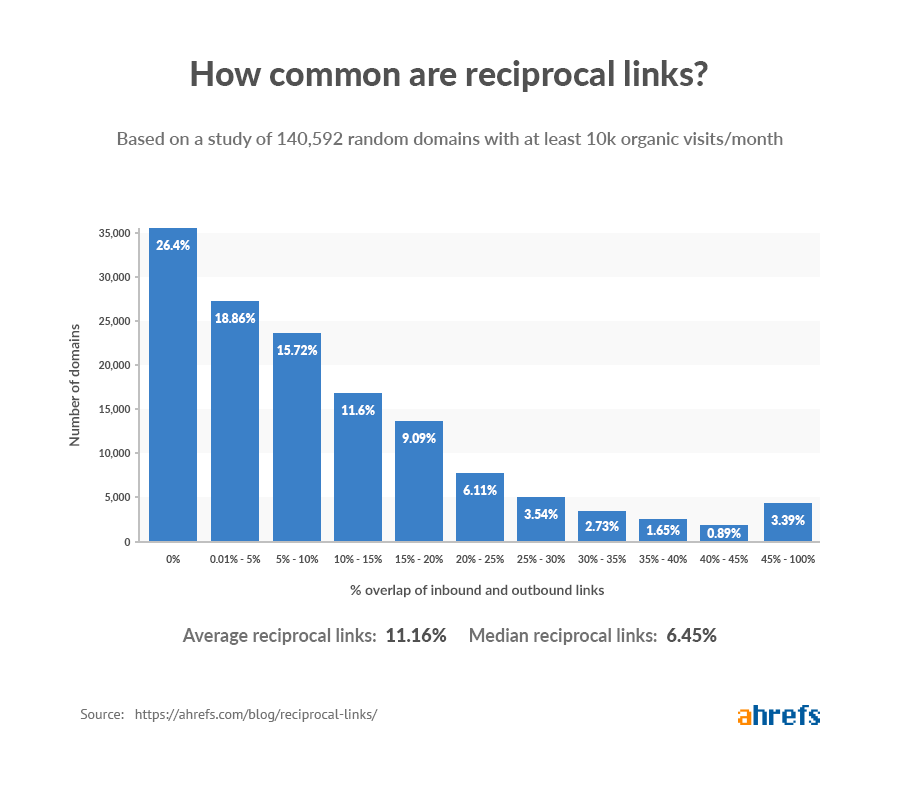
That is why seasoned SEOs separate editorial reciprocity from systematic swapping.
Editorial reciprocity looks like this:
- two sites in related spaces publish useful resources
- each link sits inside relevant content
- anchor text is natural
- there is no obvious footprint of dozens of mirrored exchanges
Manipulative swapping looks like this:
- same-page-for-same-page trades at scale
- exact-match anchors repeated across partners
- links placed on generic “resources” pages no one reads
- partners selected for metrics only, not fit
If you remember one sentence from this section, make it this one: a reciprocal link can be normal, but a reciprocal link system is easy to turn into spam.
Weighing the SEO Benefits Against the Risks
The upside is straightforward. A good exchange can get you:
- a relevant backlink
- referral traffic
- brand exposure to an adjacent audience
- a relationship you can later turn into guest posts, mentions, or co-marketing
The downside is also straightforward. If you build too many of them, or build them carelessly, you create a detectable pattern. Google’s link spam systems are designed to devalue unnatural links, so the best-case outcome for a sloppy campaign is often that the links do nothing. The worse outcome is a backlink profile full of junk you later need to clean up.
A practical rule I use is this:
Only exchange links you would still want if Google ignored them completely.
That keeps you focused on relevance, traffic, and editorial value instead of pure metric chasing.
Effective Types of Link Exchange Strategies
Once you understand the risk line, the next step is choosing the exchange format. Some are simple and workable in moderation. Some get abused fast.
Traditional Reciprocal Linking
This is the standard A ↔ B arrangement. Your site links to theirs, and theirs links to yours.
It works best when both links are placed on pages that make independent editorial sense. For example, your article on technical SEO audits links to a partner’s log analysis tutorial, while their article on crawl budget links to your site architecture checklist.
It works worst when both links are shoved into thin list posts created only to host partner links.
If you use reciprocal links, keep them:
- page-specific, not domain-wide
- content-led, not sidebar or footer-led
- occasional, not your main acquisition method
The biggest mistake here is symmetry. If every partnership follows the exact same pattern, your process leaves footprints. Vary the destination pages, vary the content types, and avoid repetitive anchor structures.
Three-Way (ABC) Link Trades
In a three-way exchange, Site A links to Site B, Site B links to Site C, and Site C links to Site A. People use this to reduce the obvious “you linked to me, I linked to you” pattern.
Search engines are not blind to this idea. Google’s broader link spam guidance focuses on manipulative intent and unnatural patterns, not just one exact exchange shape, and its SpamBrain systems continue to improve at spotting link abuse across sites used for passing links. So while a three-way trade can look less obvious on the surface, it is not some invisibility cloak.
Used carefully, ABC trades can be cleaner than direct swaps when:
- the sites are part of legitimate, adjacent brands
- the links are still contextually relevant
- each page has standalone value
- the arrangement is occasional and hard to distinguish from natural editorial linking
Used badly, they become network behavior.
If you are running multiple sites, be strict. Do not cross-link everything just because you can. Treat each site like a separate publication with its own editorial standards.
Collaborative Guest Post Swaps
This is often the safest version because the link is wrapped inside net-new content.
Here’s the better way to do it:
- You contribute a genuinely useful guest article to their site.
- They contribute one to yours, or you arrange equivalent value elsewhere.
- Each piece includes one or two relevant citations where readers would expect them.
This avoids the low-value pattern of inserting links into old articles with no editorial reason.
It also gives you a quality control layer. If a partner cannot produce a competent guest post, that tells you something about the site and its standards.
One caution matters here. Do not turn guest post swaps into assembly-line content with keyword-stuffed anchors. Google advises writing anchor text naturally and avoiding keyword cramming. If the article reads like it was built around the link, you are back in risky territory.
Proven Methods to Discover Complementary Websites
This is where most link exchange campaigns succeed or fail. Good partners are usually found through structured prospecting, not random outreach blasts.
Reverse-Engineering Competitor Backlinks
Start with competitors who rank for the same topics but are one or two tiers ahead of you, not giant publishers. Their backlink profiles usually reveal realistic partnership targets.
Pull their referring domains into a sheet and tag each domain using these labels:
- niche-relevant publisher
- software or service company
- association or directory
- guest post contributor site
- obvious SEO trade site
- not relevant
You are not looking for every site that links to them. You are looking for sites that already link to businesses like yours and publish content where your brand could fit naturally.
The fastest filtering workflow is:
- export referring domains
- remove directories, forums, and coupon sites
- open the remaining domains one by one
- ask: “Could I picture my site being mentioned here without a swap?”
- only then move the domain into your outreach list
This matters because authority metrics can trick you. Ahrefs states that Domain Rating is a relative backlink-strength metric, not a judgment of site legitimacy, and even low-DR sites can be perfectly fine. Treat authority as a filter, not a verdict.
Utilizing Advanced Google Search Operators
Search operators still work well for finding publishers, blogs, and resource pages in very specific topical pockets.
Try searches like:
intitle:"write for us" + your topicinurl:blog + your topicintitle:resources + your topic"best tools" + your topic"powered by" + keywordif you want to uncover industry blogs on common CMS footprints
But do not stop at the obvious footprints. The best opportunities usually come from editorial pages that were not created for link building.
For example:
- search product comparison keywords in your niche
- search “how to” topics adjacent to your service
- search roundups, case studies, glossaries, and template pages
When you find a promising site, check three things fast:
- are they actively publishing?
- are they linking out to relevant third-party sites?
- do the outbound links look curated or sold?
That third check saves hours.
Networking in Vetted Industry Communities and Groups
Some of the best partnerships come from existing communities because there is already context and soft trust. The trick is to use communities for relationship discovery, not for grabbing every “who wants to exchange links?” thread you see.
The higher-quality workflow looks like this:
- participate where people in your vertical actually share tactics
- note who consistently publishes useful work
- review their sites outside the community
- reach out privately only after you can name a specific fit
This is also where a platform like Rankchase can help as a screening layer. If you want a narrower pool of websites for link exchanges, mentions, or collaborations, using automated filters for niche relevance, DR, traffic patterns, and spam signals is much better than cold-sorting hundreds of random domains by hand.
That said, no matching system replaces manual review. You still need to read the site.
How to Vet Potential Partners for Maximum Safety
Finding candidates is easy. Rejecting the wrong ones is where the real skill shows up.
Establishing Baseline Traffic and Authority Metrics
Start with baseline numbers, but keep them in the right order.
I usually check:
- estimated organic traffic trend
- referring domain quality
- branded search presence
- indexation health
- authority proxy such as DR or Authority Score
A healthy partner does not need huge traffic. It needs stable signs of legitimacy.
Semrush describes Authority Score as a compound metric built from link power, organic traffic, and spam-related checks. That makes it useful as a quick comparison layer, but still not something you should trust on its own.
A practical safety rule:
- Green light: stable or gradually improving traffic, real topical pages ranking, branded presence, normal link profile
- Yellow light: flat traffic but strong niche relevance and clean content
- Red light: sharp traffic collapse, random topic spread, inflated authority with weak real rankings
If the site looks dead in search but claims huge value because of DR, walk away.
Evaluating Niche Alignment and Audience Overlap
This is the check too many people fake.
Do not ask whether the site is “in marketing.” Ask whether it serves the same moment in the user journey.
For example:
- an SEO crawler and a content brief tool can align
- an SEO agency and a web design studio can align
- a local dentist and a crypto blog do not align, even if both want links
I like a simple 1 to 5 scoring model here:
Topical relevance
1 = unrelated
3 = same broad industry
5 = tightly adjacent subtopic
Audience overlap
1 = different buyer
3 = loosely similar business audience
5 = same buyer, different need
Placement fit
1 = no logical page found
3 = could fit in a general article
5 = obvious page and paragraph for insertion
Anything averaging below 4 usually does not make my list.
Analyzing a Site's Outbound Link Profile
Outbound links tell you how a site monetizes itself.
Open five recent articles and inspect:
- how many external links appear per post
- whether links point to real brands or random commercial pages
- whether anchors are natural
- whether the links support the copy or interrupt it
Google’s guidance on qualifying outbound links also makes clear that paid or sponsored placements should be labeled appropriately, while ordinary editorial links do not need qualification. If a site sells placements but disguises everything as editorial, that is a trust problem before it is an SEO problem.
Use this mini-checklist when reviewing outbound behavior:
- Few, relevant citations usually signal editorial restraint
- Frequent casino, crypto, payday, or essay links usually signal monetized abuse
- Repeated exact-match commercial anchors are a major warning
- Author bios stuffed with keyword links often mean low standards
If you are unsure, check one layer deeper. Click through to where their outbound links go. Bad sites tend to link to other bad sites.
Critical Red Flags to Avoid When Choosing Partners
Most disasters in link exchanges are easy to avoid if you know what to look for early.
Spotting Disguised Link Farms and PBNs
Modern link farms do not always look terrible at first glance. Some have decent themes, AI-written posts, fake authors, and polished logos.
The pattern usually gives them away:
- very broad topic coverage with no real brand point of view
- articles designed to rank for easy queries across unrelated industries
- lots of outbound links to commercial sites
- thin author pages
- no visible audience engagement or real brand signals
A quick stress test helps. Search the brand name plus a few article titles. If almost no one mentions the site, no one cites it, and its “about” page feels generic, treat it with suspicion.
Another giveaway is publishing velocity with no coherence. If a site posts on legal software, dog supplements, crypto wallets, and pest control in the same week, that is usually not editorial ambition. It is inventory.
Sites with History of Sudden Traffic Drops
Traffic drops do not automatically mean a site is toxic. Sometimes the site redesigned badly, lost a few rankings, or changed content strategy.
But a sudden and sustained collapse often tells you the site was hit by a quality issue, deindexed in part, or built on tactics that stopped working.
This is where timelines matter:
- a small dip and recovery is normal
- a seasonal niche may have predictable swings
- a sharp cliff with no rebound over months deserves caution
Google’s spam documentation notes that spam-related systems and updates can cause ranking losses, and in link spam cases, previously gained value from unnatural links can simply disappear. If a prospective partner built its authority on manipulative links, you do not want to inherit association with that pattern.
Excessive or Spammy External Links
If a page has one relevant outbound link, that is normal. If every second paragraph pushes readers to another commercial domain, you are looking at a link vehicle.
Pay attention to density and intent:
- Does the article exist to help the reader?
- Or does it exist to host links?
I avoid sites where:
- most posts contain multiple transactional outbound links
- links use hard exact-match anchors again and again
- outgoing links point to industries the site clearly does not cover naturally
- old posts keep getting refreshed with awkward insertions
If the site seems more interested in placing links than building an audience, do not trade with it.
That rule alone will eliminate a lot of future cleanup work.
Executing Your Link Exchange Strategy Safely
At this point, you have a clean shortlist. Now you need to reach out without sounding like every SEO inbox cliché.
A Step-by-Step Guide to Natural Outreach
The safest outreach starts before the email.
First, identify the exact page on their site where your link could fit. Then identify the page on your site that would genuinely help their readers. If you cannot map page-to-page relevance, do not pitch yet.
A practical workflow looks like this:
-
Read three to five articles on the target site.
You need to understand tone, standards, and whether they already reference third-party resources. -
Choose one specific placement idea.
Mention the exact article and the section where your resource adds something useful. -
Lead with value, not the swap.
Start by pointing out why your page helps their readers. If there is a reciprocal idea, mention it later and lightly. -
Offer options.
A contextual edit, a fresh contribution, or a resource-page addition gives them flexibility. -
Keep volume low.
Ten strong emails beat one hundred vague ones every time.
The best-performing outreach I have seen usually sounds like peer-to-peer editorial communication, not transaction language.
High-Converting Email Pitch Templates
Here are two templates that feel natural and still get to the point.
Template 1: Contextual insertion
Subject: quick content suggestion for [article topic]
Hi [Name],
I was reading your piece on [article title] and noticed the section about [specific point].
We recently published a resource on [topic] that goes deeper into [specific angle]. I think it could fit well there because it helps readers with [clear outcome].
If helpful, I can point you to the exact section that matches.
Also, if you ever need a supporting reference on [your adjacent topic], happy to share one from our side where it makes sense.
Best,
[Name]
Template 2: Guest post collaboration
Subject: possible content collaboration
Hi [Name],
I work on content for [site]. We cover [brief topic area] for [audience type].
I had an idea for a guest article on [working title] that would fit your blog because it builds on your recent coverage of [relevant topic]. Inside the article, I’d naturally reference a supporting resource from our site where useful.
If you’re open to it, I’d also be glad to publish something from your team on our side if there’s a topic overlap.
Would you like me to send a short outline?
Best,
[Name]
Why these work:
- they reference a real page
- they suggest a clear reader benefit
- they leave room for a collaboration without sounding like a bulk trade request
Best Practices for Anchor Text Diversity
Anchor text is where people over-optimize and ruin an otherwise solid placement.
Google’s link best practices recommend writing anchor text naturally and resisting keyword stuffing. That applies just as much to exchanged links as any other link.
A healthy anchor mix usually includes:
- brand anchors
- partial-match anchors
- descriptive phrase anchors
- plain URL anchors in some contexts
For example, if you want a link to a page about ecommerce category SEO, these are safer than hammering one exact phrase every time:
- Rankchase guide on category page SEO
- this category SEO checklist
- their breakdown of ecommerce taxonomy issues
- Rankchase
Avoid repeating the same money term across partners. If five exchanged links all use the identical commercial anchor, that pattern is louder than people think.
Post-Exchange: Monitoring and Maintaining Link Health
The work is not done when the link goes live. Good partnerships need light maintenance. Bad ones need fast decisions.
Tracking Active Placements Over Time
Links get removed, changed to nofollow, redirected, or buried after site updates. Some partners also quietly swap your link out for another client later.
Set a monthly check for:
- link still live
- destination URL still correct
- page still indexed
- anchor still natural
- surrounding content still relevant
Google Search Console’s Links report can help you understand your external link profile and spot top linking sites or unfamiliar domains, though it shows a sample rather than a full commercial backlink index. It is useful for validation, not full prospecting.
If you manage more than a handful of exchanges, keep a simple tracker with:
- partner domain
- linked page
- your destination page
- anchor text
- date placed
- last checked
- status
That one sheet prevents a surprising amount of chaos.
When to Disavow Bad Link Partners
Most bad links do not require panic. Google has said many spammy links are simply ignored, and Search Console documentation notes that for known spam sites, Google typically ignores those links. The disavow tool is still available, but historically Google has recommended using it carefully, especially when links are part of schemes or manual-action cleanup.
So when should you actually disavow?
Use the stricter threshold:
- the partner turned into obvious spam
- you participated in manipulative exchanges at scale
- you received a manual action or strong warning signs
- removal requests failed and the links are clearly unnatural
Do this in order:
- request removal
- document the outreach
- disavow only the domains that are clearly problematic
- keep building better links so the bad slice becomes less significant over time
Disavow is a cleanup tool, not a routine maintenance button.
Frequently Asked Questions About Link Trading
Are link exchanges against search engine guidelines?
Excessive link exchanges intended to manipulate rankings are against Google’s spam policies. Relevant, editorially justified links between related websites are a normal part of the web. The difference is whether the link exists for users first or for ranking manipulation first.
How many swapped links are safe for a backlink profile?
There is no official safe number. The practical answer is to keep exchanged links as a small minority of your overall backlink profile and avoid obvious patterns. If too many of your referring domains come from reciprocal arrangements, that is a problem even if each individual link looks decent.
A good gut check is this short checklist:
- Would this link make sense without a trade?
- Is the partner topically adjacent?
- Does the placement sit inside real content?
- Is the anchor natural?
- Would I be comfortable showing this pattern to a manual reviewer?
If you hesitate on two or more of those, skip the deal.
Can search algorithms easily detect three-way exchanges?
They can detect suspicious patterns far beyond direct A ↔ B swaps. Google’s link spam systems and SpamBrain are designed to identify unnatural linking behavior across sites, not just one simplistic footprint. A three-way exchange may be less obvious visually, but if it is part of a broader manipulative pattern, you should assume it can be devalued.
How quickly do reciprocal links impact search rankings?
If the link is crawled, indexed, and trusted, you might see movement in a few weeks. Sometimes it takes longer. Sometimes nothing happens because the link carries little weight, or because Google discounts it.
That is another reason to choose partners based on relevance and traffic potential, not just hoped-for ranking lift. The best exchanges help you even when rankings move slowly or not at all.